OCP Global Summit 2026 — attendee guide
San Jose McEnery Convention Center · Mon Oct 12 – Thu Oct 15 · read with a power / power-quality product lens · updated Oct 14
WhatsApp copy
OCP Global Summit 2026 - San Jose McEnery Convention Center, Oct 12-15 (sold out).
Mon: breakouts 12-3:30, keynotes 4-6:05 (Lisa Su, Meta, Arm, Broadcom, NVIDIA), social 6:15.
Tue: keynotes 9-11:30 incl. ABB+Eaton "Shifting to DC power distribution" 10:50; expo opens 11:30; NVIDIA 800 VDC talk 4:10 + "Intelligent Power Smoothing at the Vera-Rubin Rack" 4:25.
Wed: Future Technologies Symposium; Vertiv "800 VDC grid-to-rack" 4:10; "DC Fault Manager" 4:45; Block Party 5-7.
Thu: NVIDIA MGX power rack 1:40; TI 800V DC/DC 2:45. Expo closes 2pm.
Guide: https://artifact.sahirm.com/a/ocp-global-summit-2026/
Today: Tue Oct 13 — your plan (9:00 → leave 1:25)
- 9:00–9:15OCP Welcome AddressSouth Hall
- 9:15–9:35⭐ Microsoft: Reynold D’Sa, “Intelligence Infrastructure”South Hall · author of the Cobalt per-VM power-capping blog
- 9:35–10:50Oracle · WOCP · Lattice/AMI control plane · HPE · IntelSouth Hall · stay seated, expo is closed until 11:30
- 10:50–11:10⭐ ABB + Eaton: “Shifting to DC Power Distribution in Data Centers”South Hall · the must-see of the morning
- 11:10–11:30⭐ Google: Partha Ranganathan, “Intelligent Infrastructure for the Intelligence Era”South Hall
- 11:30–12:50Expo booths, eat on the go (no talks worth it in this window)Power booths, in order: Eaton, ABB, NVIDIA, then Vertiv, Delta, TI if time · grab food from the Front Yard lunch (until 1:00)
- 1:00–1:25⭐ Andy Bechtolsheim (Arista): “The Gigawatt AI Data Center Era”Room 210CG · walk over from the expo by 12:55
- 1:25Hit the roadDrop the car, then the mover
What OCP is: 8 facts
- Who. The Open Compute Project was started by Facebook (now Meta) in 2011 to open-source hyperscale data-centre hardware designs.
- This year. 2026 Global Summit, Oct 12–15, San Jose McEnery Convention Center. Theme: “Scaling Innovation for the AI Era”.
- Size. 22 technical tracks, executive talks, Innovation Village demos, the Future Technologies Symposium and co-located workshops.
- Sold out. Registration sold out; no onsite registration. Your badge is the scarce thing this week.
- Expo. Main Expo Hall = Halls 1–3; Expo Ballroom = Grand Ballroom 220A. Expo opens Tue 11:30 am, closes Thu 2 pm.
- Power is a headline. Two dedicated power tracks (AI Open Data Center / Power Distribution, and Rack & Power): 800/1500 VDC, megawatt racks, direct-to-server DC, grounding, backup.
- The big shift. AC → 800 VDC distribution for AI racks is the year’s power story. ABB + Eaton keynote it Tuesday; NVIDIA, Vertiv, TI and Delta all present on it.
- Last San Jose year. 2027 moves to Moscone Center, San Francisco, Oct 4–7.
Day by day
go optional · all times Pacific · check the OCP app for rooms and late changes
Mon Oct 12 (today)
- 4:00–6:05 pmOpening keynotes (South Hall)Su (AMD), Janardhan (Meta, “Concrete to Code: AI infrastructure at gigawatt scale”), Awad (Arm), Khamisy (Broadcom), Buck (NVIDIA). Meta’s gigawatt talk is the one most about power.
- noon–3:30 pmBreakoutsOptional; skim the app for anything in the two power tracks.
- 6:15–7:30 pmOpening Night SocialEasiest networking of the week.
Tue Oct 13
- 9:00–11:30 amKeynotesMust-see: 10:50 ABB (Paolo Catapane) + Eaton (Peter De Bock): “Shifting to DC Power Distribution in Data Centers”. Also Microsoft (9:15), Google’s Partha Ranganathan (11:10).
- 11:30 am–7 pmExpo opensWalk the power booths first (list below).
- 12:50–1:05 pmDelta: Microgrids at ScaleResilient power infrastructure for AI data centres.
- 4:10–4:30 pmNVIDIA: 800 VDC AI FactoriesFrom architecture alignment to industry deployment.
- 4:25–4:40 pmNVIDIA: Intelligent Power Smoothing at the Vera-Rubin RackThe most power-quality talk of the week: smoothing synchronous GPU load swings that hit the grid as power oscillations. Note it overlaps the 800 VDC talk; prioritise this one.
- 1–5 pmCo-located workshops (DMTF, OIF, IPEC)Networking/optics/manageability; skip unless curious.
- 5–7 pmBooths & BitesSecond pass on the expo.
Wed Oct 14
- 8 am–5 pmFuture Technologies SymposiumResearch track; dip in.
- 4:10–4:25 pmVertiv (Scott Armul): 800 VDC and the AI factoryGrid-to-rack architectures as racks go 300 kW → 600 kW → MW-class.
- 4:45–5:00 pmThe DC Fault ManagerOpen fault coordination for 800 VDC data centres; protection is where PQ instrumentation fits.
- 5–7 pmBlock PartyNetworking.
Thu Oct 15
- 8 am–2 pmLast expo hoursFollow-ups; the expo closes at 2 pm.
- 1:40–2:00 pmNVIDIA: MGX Power Rack Reference Design
- 2:45–3:05 pmTexas Instruments: 800V DC/DC designTopologies and trade-offs.
Slides (2 of 184 recorded sessions)
Pulled from OCP’s session recordings, one page per slide (official decks aren’t posted yet). Main-stage keynote PDFs include a few speaker shots. More are added as they process.
Your sessions + 800 VDC talks (2)
| When | Session | Rec. | |
|---|---|---|---|
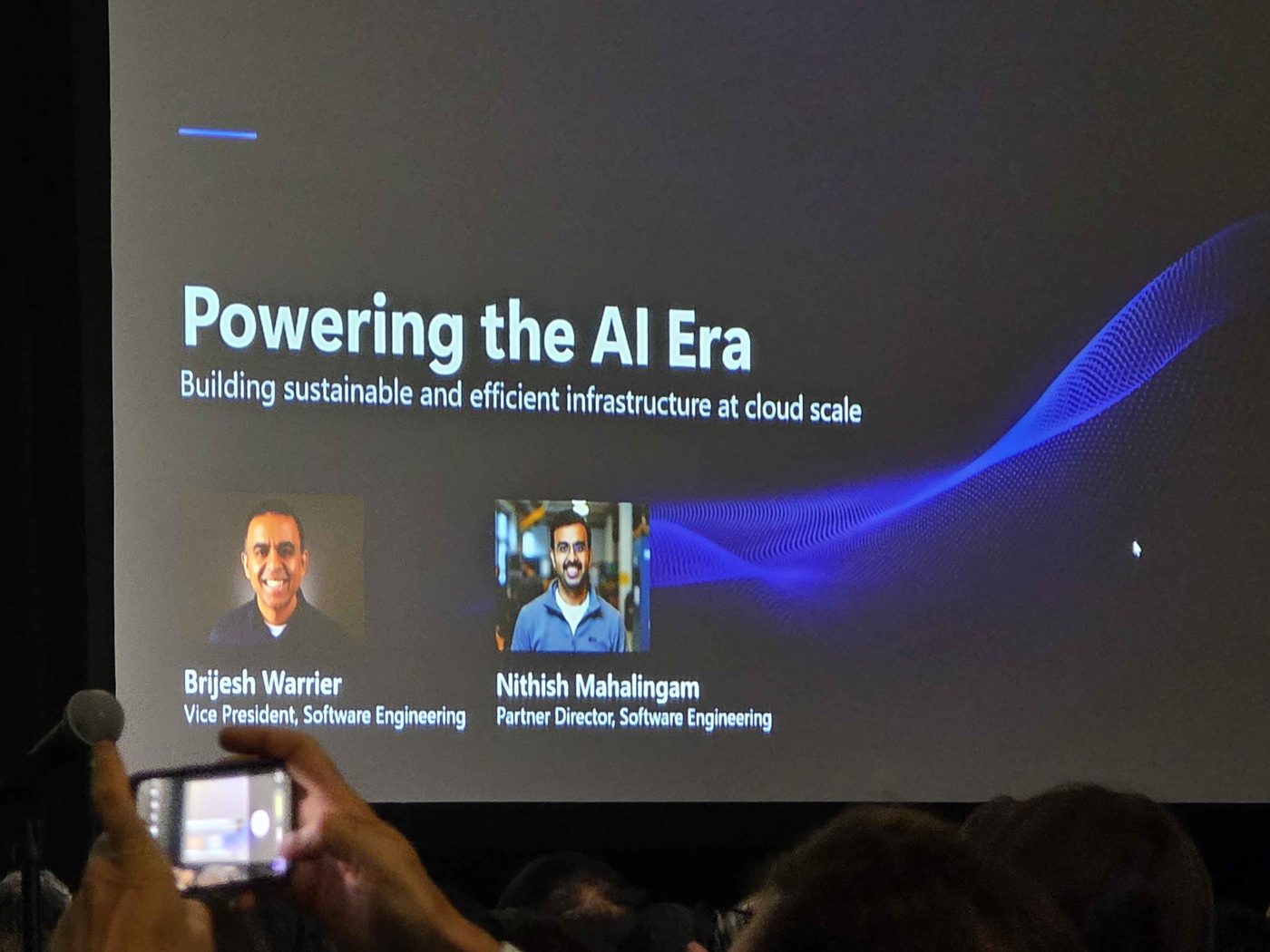
| Mon Oct 12 02:30 PM | Powering the AI Era: Building Sustainable and efficient Infrastructure at Cloud Scale presented by Microsoft Brijesh Warrier, Nithish Mahalingam · 210AE | 0.9 MB | video |
| Mon Oct 12 02:55 PM | Beyond Power Density: Building a Safe 800V DC Ecosystem presented by Eaton Joe Skorjanec · 212 | 1.5 MB | video |
Session notes
One card per session. Chui fills them in from your photos, voice notes and messages in the thread. Tap a card to open it.
Mon Oct 12
Attended Powering the AI Era: Building Sustainable and Efficient Infrastructure at Cloud Scale (presented by Microsoft)Mon Oct 12 2:30 pm · 210AE · Brijesh Warrier (VP Software Engineering) · Nithish Mahalingam (Partner Director, Software Engineering)
Slides: Not in the app. QR codes on the slides link to their papers. Recording: 14-31-16.wav (20 min).
- Setup (Warrier): IEA sees data-centre power at ~2.5× by 2035 (up to 3×); AI servers +31% in 2026; hyperscaler capex ~$650B in 2026, so even 1% efficiency ≈ $6.5B.
- Core idea (Mahalingam): power has to become software-defined. Compute, network and storage are pooled and scheduled; power is still static, decided separately by facility, scheduler and hardware cap, which strands power.
- Three inputs: electrical topology, power telemetry, workload context (priority, flexibility). Observe → decide → act loop, with hardware capping as the safety backstop.
- Power steering (power to the work): budgets flow down row → rack → server → VM while telemetry flows up; plan for real demand, not worst case. For inference, prefill (power-hungry) and decode (memory-bound) get different hardware (their Splitwise paper).
- Power shaping (work to the power): expose per-power-domain headroom to the scheduler and the inference router so jobs land where there's slack. Azure sees some rows run hot while others run cold.
- Capping: priority-aware throttling. Software capping took seconds, so it moved into the Cobalt 200 CPU: up to 20% more oversubscription with no hit to critical work. Loops run at ms (capping), seconds (routing), slower (placement) and months (planning).
- Ask to OCP: open telemetry (standard power + capping signals), open topology, open controls, via the Hardware Management and Rack & Power groups. Also mentioned: capacitor-based backup units in the rack (separate OCP talks).
- Powerside angle: the whole stack runs on power telemetry at row/rack/server level, and they're asking OCP to standardise it. That's a direct opening for metering.
Attended Beyond Power Density: Building a Safe 800V DC Ecosystem (presented by Eaton)Mon Oct 12 2:55 pm · 212 · Joe Skorjanec (Eaton)
Slides: Speaker said “these slides will be available later”. Recording: 14-55-31.wav (20 min). Eaton booth E7.
- Why 800 VDC: <60 VDC was the low-shock comfort zone (48/50 V telecom heritage), but rack power economics broke it. 800 V means less current, less copper, more density. 800 VDC is still “low voltage” (LV goes to 1500 V), not HVDC.
- The change is bigger than voltage: conversion moves out of the rack, so 800 V now travels through the facility. Five domains: conversion, distribution, protection, people, operations.
- Three architectures: Side Power Rack (ex-“sidecar”, AC→DC next to the compute rack, point-to-point ~125 A ≈ 100 kW circuits), Power Center (row/pod, busway or RPP drops at 800 V), and facility-wide MV AC → 800 VDC (e.g. SST).
- Side power rack is easier to make safe: short runs, one source per load, contained isolation zone, locked rear doors, interlocked connectors. Power Center has three safety zones and multi-source fault behaviour, so it needs full system studies.
- DC has no zero crossing, so arcs sustain. Protection must coordinate at four layers: detection (overcurrent, insulation, residual), fast interruption (SSCBs), physical isolation (air gap), backup (fuses).
- EPO is a sequence: stop conversion → trip protection → isolate batteries/caps → discharge stored energy → verify. Connectors can't be pulled under load; the latch sends a trip first.
- Grounding: three competing schemes. Pick one and coordinate protection around it. Hot-swap culture has to change: some swaps will need de-energising and qualified staff.
- Five principles: define boundaries, limit fault energy (fast SSCBs), prevent energised access, isolate every source (caps, BBUs), design for the technician.
- Powerside angle: insulation monitoring and fault detection on the DC bus are explicitly called out as needed beyond overcurrent. That's measurement territory.
Attended Scaling Direct Current in Data Centers: From Proven Industrial Concepts to Open Standardization (presented by Phoenix Contact)Mon Oct 12 3:20 pm · 212 · Martin Wetter (Phoenix Contact)
Slides: Not in the app. Recording: 15-19-31.wav (15 min). Phoenix Contact booth in the expo.
- Phoenix Contact has run an industrial DC grid at its HQ factory for ~2 years (€35M site, ~400 staff). 30 kV AC in, active front-end to a 700 VDC bus (upgrading to 800 V), 700 kW modular AC/DC.
- On the DC bus: 110 kWp PV direct, 300 kWh second-life EV battery, bidirectional EV chargers (2×150 kW, 8×60 kW), DC lighting, building control and production machines.
- No frequency in DC, so the grid is controlled by bus voltage through a master grid controller (German ODCA/ZVEI DC-Industrie spec), running on their PLCnext platform.
- Risks they had to solve: short-circuit selectivity (full live short-circuit testing in their DC lab), and arcing when connectors are pulled under load. Their “Arc Zero” connector bypasses current through a semiconductor so it unplugs dead.
- Data centres: same benefits as industry (fewer conversions, peak shaving, storage, less copper), but the real driver is power density: 10 kW racks → 100–200 kW today → 1 MW, only possible with 800 VDC.
- Timeline view: industry adoption is ~5 years out; data centres will go much faster. The blocker is fragmented specs, and OCP is the right place to unify them.
- Powerside angle: a working DC microgrid with PV, storage and bidirectional chargers on one bus is a real-world source of DC power-quality data (voltage regulation, transients, short-circuit events).
Attended Opening keynotesMon Oct 12 4:00–6:05 pm · South Hall · Su (AMD) · Janardhan (Meta) · Awad (Arm) · Khamisy (Broadcom) · Buck (NVIDIA)
Slides: Recording: 16-04-35.wav (1h48m, starts during the OCP welcome).
- OCP (Tchaparian): heading for 700+ members, contributions +30%/yr. Scope is now “chip to grid”: 800 VDC specs with 1500 VDC next, IT/OT telemetry, utility interface specs, and Open Rack Wide. IDC raised OCP-recognised equipment to ~$890B by 2030. New “OCP Nexus” chatbot.
- AMD (Lisa Su): 2026 is “the year of inference” (~60% of market); agentic traffic up 14× this year. Helios rack (72 GPUs, ~7,000 lb, OCP Open Rack Wide, co-built with Meta) shipping since Sept. Claims ~30% more tokens/$. New Helion agentic CPU rack (orders from Nov 26, to be contributed to OCP) and the “Murano” EPYC CPU.
- Meta (Janardhan): Prometheus cluster in Ohio: 30+ structures, built in tents that go up in months, not years. Own long-haul back-end network and MetaRoCE (open-sourced). AI-designed concrete: 19% less carbon, 43% faster cure, cost-neutral (open-sourced). Target ~2 interruptions per 8k GPUs per day. Next: Hyperion, ~5 GW at one site in Louisiana.
- Arm (Awad): projected world need by 2030 went from 160 GW to 220 GW in a year (+60 GW ≈ 67M US homes). Agents each need their own VM, so CPU demand is spiking. New white paper on CPU performance for agentic AI (with Fujitsu, OpenAI, Meta).
- Broadcom (Khamisy): scale-up / scale-out / scale-across. Ethernet for all three (ESUN + SUE standards; 175 members, 5+ hyperscalers in production). Copper inside the rack is extended to ~2 m at double the bandwidth; hybrid copper+optics beyond that; deep buffers for cross-region.
- NVIDIA (Buck): Vera Rubin in full production; contributing the 3rd-gen MGX rack (liquid-cooled busbar, quick disconnects, standard flow rates) to OCP. First 800 VDC AI factory being built to the OCP draft standard: “45% less copper”, scales from today's ~100 kW racks to 1 MW. Vera CPU rack for agentic workloads; DSX reference design for full AI-factory builds.
- Powerside angle: every keynote framed power as the constraint (GW-scale sites, 220 GW demand, 800 VDC). OCP explicitly adding IT/OT telemetry and utility-interface specs is the opening for metering and PQ.
Tue Oct 13
Planned Intelligence Infrastructure: Scaling AI for the Frontier EraTue Oct 13 9:15 am · South Hall · Reynold D’Sa (Microsoft), lead author of the Cobalt power blog
- No notes yet. Send photos, voice notes or text in the thread and Chui adds them here.
Planned Shifting to DC Power Distribution in Data Centers: A Collaborative JourneyTue Oct 13 10:50 am · South Hall · Paolo Catapane (ABB) · Peter De Bock (Eaton)
- No notes yet. Send photos, voice notes or text in the thread and Chui adds them here.
Planned Intelligent Infrastructure Powering the Intelligence RevolutionTue Oct 13 11:10 am · South Hall · Partha Ranganathan (Google)
- No notes yet. Send photos, voice notes or text in the thread and Chui adds them here.
Skipped Microgrids at Scale: Resilient Power Infrastructure for AI Data Centers (presented by Delta)Tue Oct 13 12:50 pm · Expo Hall Theater · Nick Baileys (Delta)
- No notes yet. Send photos, voice notes or text in the thread and Chui adds them here.
Planned The Gigawatt AI Data Center EraTue Oct 13 1:00–1:25 pm · 210CG · Andy Bechtolsheim (Arista)
- No notes yet. Send photos, voice notes or text in the thread and Chui adds them here.
Planned 800 VDC AI Factories: From Architecture Alignment to Industry DeploymentTue Oct 13 4:10 pm · 210CG · Mike Tu · Jared Huntington (NVIDIA)
- No notes yet. Send photos, voice notes or text in the thread and Chui adds them here.
Planned Intelligent Power Smoothing at the Vera-Rubin RackTue Oct 13 4:25 pm · LL21DE · Gabriele Gorla · Rouslan Dimitrov (NVIDIA)
- No notes yet. Send photos, voice notes or text in the thread and Chui adds them here.
Wed Oct 14
Planned Future-Readiness for the 800 VDC Transition (presented by Vertiv)Wed Oct 14 4:10 pm · Expo Hall Theater · Scott Armul (Vertiv)
- No notes yet. Send photos, voice notes or text in the thread and Chui adds them here.
Planned Solid-State Circuit Breaker (SSCB) and DC Fault ManagerWed Oct 14 4:45 pm · 210CG · Ke Sun
- No notes yet. Send photos, voice notes or text in the thread and Chui adds them here.
Thu Oct 15
Planned MGX Power Rack Reference DesignThu Oct 15 1:40 pm · 230A · Jared Huntington (NVIDIA)
- No notes yet. Send photos, voice notes or text in the thread and Chui adds them here.
Planned 800V Data Center DC/DC Design Considerations, Topology Comparisons, and Trade-offsThu Oct 15 2:45 pm · 230A · David Reusch
- No notes yet. Send photos, voice notes or text in the thread and Chui adds them here.
Power booths to walk
| Company | Why |
|---|---|
| NVIDIA | 800 VDC AI factories, Vera-Rubin power smoothing, MGX power rack. |
| ABB | Keynoting the move to DC distribution. |
| Eaton | Same keynote; power distribution and protection. |
| Vertiv | Grid-to-rack 800 VDC; Scott Armul’s Wed talk. |
| Delta Electronics | Microgrids for AI data centres. |
| Texas Instruments | 800 V DC/DC conversion silicon. |
Five questions to ask at every power booth
- Where are you measuring power quality today in an 800 VDC rack: at the facility AC side, the rectifier, or on the DC bus?
- How big are the synchronous GPU load steps you see at the rack and at the utility meter, and how fast?
- What does the utility / grid operator ask you for on flicker, harmonics or oscillation before connecting an AI campus?
- Who owns power telemetry, facilities or the IT/infra team, and what do they buy?
- What is missing from today’s meters for DC distribution?
Keynotes
| When | Who | Company | Title |
|---|---|---|---|
| Mon 4:15 | Lisa Su | AMD | Building the Next Era of AI Infrastructure |
| Mon 4:50 | Santosh Janardhan | Meta | Concrete to Code: Engineering AI Infrastructure at Gigawatt Scale |
| Mon 5:10 | Mohamed Awad | Arm | The Agentic Decade Starts with Open Infrastructure |
| Mon 5:30 | Asad Khamisy | Broadcom | Scaling AI Infrastructure Through Open Innovation |
| Mon 5:45 | Ian Buck | NVIDIA | AI Factories at Scale |
| Tue 9:15 | Reynold D’Sa | Microsoft | Intelligence Infrastructure: Scaling AI for the Frontier Era |
| Tue 9:35 | Pradeep Vincent | Oracle | Scaling AI Infrastructure Responsibly Through Open Standards |
| Tue 10:00 | Ford Tamer / Sanjoy Maity | Lattice / AMI | The Open Control Plane |
| Tue 10:15 | Trish Damkroger | HPE | Scalable and Open AI Solutions |
| Tue 10:30 | Nic Dubé | Intel | From Models to Systems |
| Tue 10:50 | Paolo Catapane / Peter De Bock | ABB / Eaton | Shifting to DC Power Distribution in Data Centers |
| Tue 11:10 | Partha Ranganathan | Intelligent Infrastructure Powering the Intelligence Revolution |
Reading: POLCA — Power Oversubscription in LLM Cloud Providers
- Microsoft Azure paper (Patel, Choukse, Zhang, Goiri, Warrier, Mahalingam, Bianchini), arXiv 2308.12908, Aug 2023.
- Power, not space, is the binding constraint for dense GPU clusters: each data centre has a fixed power budget set by generators and utility contracts.
- LLM inference clusters rarely hit their provisioned peak, so there is room to oversubscribe; training clusters only have ~10% headroom because synchronous training creates large, coordinated power peaks.
- POLCA uses GPU power capping and frequency scaling with two cluster-level thresholds, throttling lower-priority work first, to stay under the budget.
- Result in simulation on production traces: ~30% more servers in the same inference cluster with minimal performance loss and few throttling events.
- Why it matters at OCP: the same synchronous swings that limit oversubscription are what NVIDIA’s Vera-Rubin power smoothing and the 800 VDC work are trying to tame. That load profile is a power-quality problem as much as a capacity one.
Logistics
- Venue: San Jose McEnery Convention Center. Keynotes in South Hall; Expo Halls 1–3; Expo Ballroom 220A.
- Expo hours: Tue 11:30–7 · Wed 9–5 · Thu 8–2.
- Evenings: Opening Night Social Mon 6:15–7:30 · Booths & Bites Tue 5–7 · Block Party Wed 5–7.
- Co-located workshops (DMTF, OIF, IPEC Tue 1–5; SONiC Wed) are included with registration.